
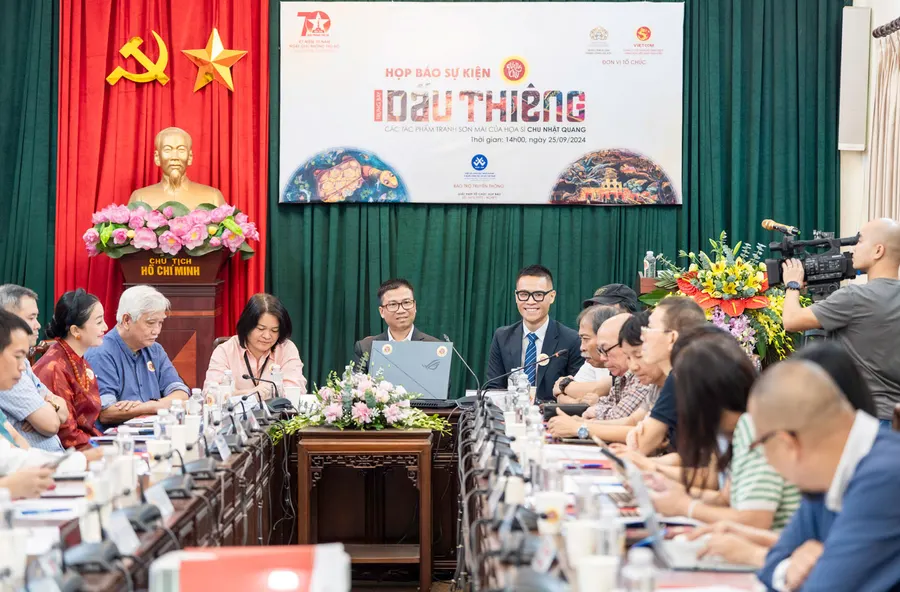
The lacquer painting exhibition "Dấu thiêng" attracted particular attention from the press.
The exhibition will take place from 5 to 15 October at the Thang Long Imperial Citadel, celebrating the 70th anniversary of the Liberation of the Capital (10 October 1954 – 10 October 2024).
"Dấu thiêng" presents 52 lacquer works by artist Chu Nhật Quang depicting the landscapes of the homeland and national heritage sites, in an artistic style that combines the traditional and the modern, divided into four themes.
The theme "Khởi" (Beginning) opens the exhibition with 14 lacquer paintings focusing on still life. In these works, the young artist seeks not only to recreate familiar everyday objects such as fruit, ceramic vases and household items, but also to give them new life through a subtle combination of colour and lacquer texture.
Each work reflects the artist's vivid memories of the time he spent learning pottery, when he discovered the refinement and unique beauty in every simple form. Each painting is not merely a display but a contemplation of the aesthetic values of a simple yet meaningful life.
Chu Nhật Quang's grandfather, painter and People's Artist Chu Mạnh Chấn, had a profound passion for art and devoted himself to restoring and preserving the cultural heritage of the villages of northern Viet Nam through lacquer painting. His father, Meritorious Artist Chu Lượng, former Director of the Thang Long Water Puppet Theatre, has dedicated his whole life to traditional Vietnamese water puppetry and has also made a considerable contribution to preserving and developing this distinctive national art form.
Although living amid urbanisation and the pace of modern life, the young artist has always maintained strong ties with traditional Vietnamese culture and constantly strives to bring the spirit of his homeland into each of his works.
Chu Nhật Quang continues the family tradition by developing lacquer painting, an art form that demands meticulousness, refinement and creative vision. His greatest source of inspiration has always been his homeland and his people, even though he was exposed to Western culture during his years of study and research abroad. These experiences broadened his horizons and helped him absorb the latest trends in global art and culture, which he then applies in his creative work.
Attending the press conference, artist Thành Chương expressed his confidence in the path Chu Nhật Quang has chosen. He believes the young artist will succeed because an artist needs innate talent and, above all, passion and hard work, and Chu Nhật Quang has both. In his view, the artist has made a good start; his personality and style are already clearly formed; he has absorbed modern values; and he has a strong aesthetic sense and outstanding thinking, together with a deep concern for and devotion to the nation's traditional values. This is an important quality that artists, especially the younger generation, should pay particular attention to.
Poet Nguyễn Quang Thiều, President of the Viet Nam Writers' Association, commented: "By inheriting and developing his family's artistic legacy, Chu Nhật Quang has contributed to the diversity and richness of modern lacquer art, demonstrating a harmonious blend of the traditional and the contemporary. His works offer audiences fresh and profound aesthetic experiences."
A representative of the Organising Committee said that the presentation of the "Dấu thiêng" paintings is not simply an artistic showcase but also a journey back to one's roots, a reminder of the importance of preserving and promoting the craft of lacquer painting and traditional cultural values in the modern world.
The works in the "Dấu thiêng" exhibition are divided into four themes: Khởi (Beginning), Cội (Roots), Linh (Spirit) and Nôi (Cradle). The theme "Cội" comprises 17 paintings that take viewers on a deep journey to explore the culture and heritage of the Vietnamese nation, such as the Thang Long Imperial Citadel, the Turtle Tower, the One Pillar Pagoda and Thầy Pagoda. Through the image of Mother Âu Cơ and the art of water puppetry, the artist evokes stories of the nation's sacred origins and the silent sacrifices of farmers, who have nurtured and preserved an age-old culture. The paintings set tradition against modernity, as a reminder of the risk that folk art may fade away. Images of a banyan tree beside a pond, a buffalo carrying a temple on its back, and farmers working on terraced fields all convey a message about the bond between people and nature and long-standing cultural values. Water puppetry, a symbol of traditional Vietnamese art, is also depicted in a spirit of preservation and development in a modern context.
The theme "Linh", with nine paintings, continues to evoke nostalgia for culture and heritage. The artist recreates the old water pavilion stage with its water puppet performances, the famous Thầy Pagoda and scenes of everyday life in ancient villages. From images of a monk in meditation to the lotus flower symbolising enlightenment, each painting is imbued with philosophy and spirituality, reflecting the aspiration to seek truth and self-perfection. The Thang Long Imperial Citadel and the Turtle Tower are also vividly portrayed, expressing the endurance of Vietnamese culture through all the vicissitudes of history. These works are not only a reminder of the nation's historical values but also a call to protect cultural heritage in the modern context.
Finally, the theme "Nôi", with 12 paintings, evokes memories of the homeland, village communal houses and water puppetry, the distinctive cultural symbols of Viet Nam's farming communities. The water puppet paintings not only recreate the life and customs of the wet-rice civilisation but also clearly depict the nation's unique cultural identity. Through images such as the phoenix, the fish and lively puppets, the artist conveys a message of harmony between people and nature and the hope of preserving the nation's precious traditional values across generations.
Below are some of the works on display at the "Dấu thiêng" exhibition: