
The colleges – Vietnam Maritime College No. I, Da Nang Vocational College, Technical College No. II, Ho Chi Minh City College of Transport and the College of Mechanics and Irrigation – received advice and support from Australian experts throughout the pilot, applying to their practical training activities the knowledge gained from the course "Competency-based training and assessment strategies for TVET lecturers and trainers in the logistics sector", organised by the project at the end of 2023.
The CBTA approach is based on the Australian model of training and assessment against industry standards to ensure that graduates meet the requirements of the sector.
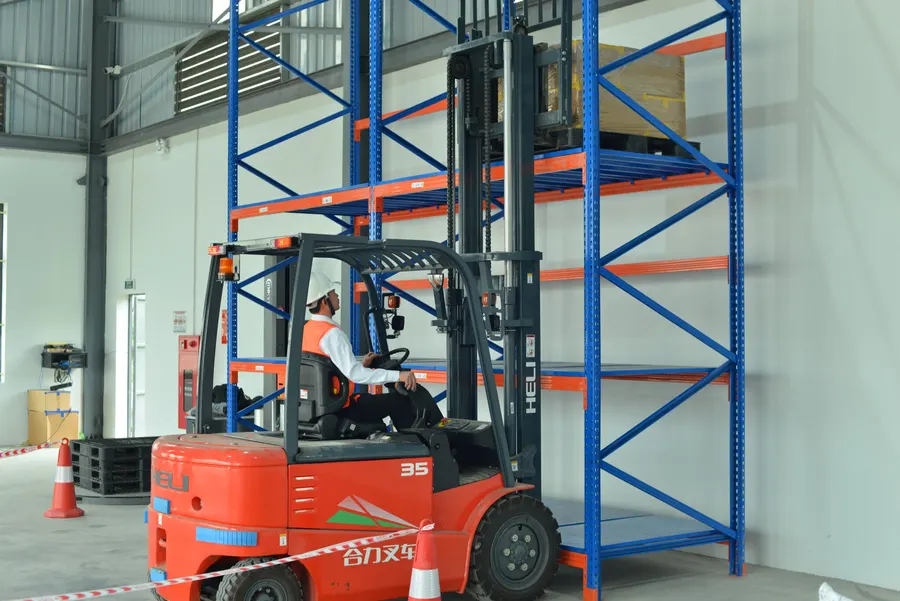
The modules selected for pilot training were: Forklift operation (Vietnam Maritime College No. I), Receiving and storing goods (Da Nang Vocational College), Following safe work procedures when handling goods (Technical College No. II), Packing goods for dispatch (Ho Chi Minh City College of Transport), and Picking and processing orders (College of Mechanics and Irrigation). A total of 84 learners took part in the pilots, including 35 men, 49 women and 2 learners with disabilities (an average of 15–18 learners per college).
Learners in the CBTA pilot class at Vietnam Maritime College No. I
The colleges worked closely with enterprises to develop training programmes, deliver the training and assess learning outcomes. During the course, learners practised in the colleges' simulated warehouses and workshops and also gained real-world experience at enterprises. The colleges also applied knowledge on inclusion gained from the Aus4Skills programme to ensure gender equality and support learners with disabilities.
Learners in the pilot class at Technical College No. II
All participating learners were recognised as competent at the review in March 2024. The participating colleges and enterprises all rated the CBTA approach highly and confirmed their readiness to scale it up to other modules and training programmes of the colleges.
Learners in the pilot class at Ho Chi Minh City College of Transport
"The forklift operation course using the CBTA approach was really useful. Up to 90% of the course time was spent on practical training at both the college and the enterprise, so I can now drive a forklift confidently and smoothly," said Ms Đỗ Thị Thu Trang, a lecturer in the Faculty of Economics and a learner on the pilot course at Vietnam Maritime College No. I.
Dr. Nguyễn Văn Chương, Rector of the College of Mechanics and Irrigation, commented on the project's results: "The project has had a positive impact on lecturers' teaching methods. We can apply the CBTA approach to other modules."
The enterprises also gave positive feedback on their participation in the pilot. "We find the CBTA approach very effective; it helps us save time and costs in recruitment and training. We will continue to work with the college in activities to transfer the value gained from the Aus4Skills programme," said Mr Nguyễn Huy Trường, Director of Minh Giang International Import-Export Trading Co., Ltd. (which took part in the pilot project at Vietnam Maritime College No. I).
Learners in the pilot class at Da Nang Vocational College
The pilot programme also yielded useful lessons for applying the CBTA approach in other courses and colleges, including: the support of college leadership; the need for participating lecturers to master the CBTA approach; the constant involvement of enterprises; training standards closely aligned with enterprise requirements; flexible scheduling of study time; and well-designed simulated warehouses that comply with safety regulations and are fully equipped for learning.
The participating colleges also shared many lessons learned from the pilot process. They recommended that management agencies complete the legal framework to facilitate the application of CBTA, including updating the learning outcome standards of training fields and occupations.
Learners in the pilot class at the College of Mechanics and Irrigation
The Government of Australia, through the Aus4Skills programme, will continue to support the development of the TVET system, including innovation in training and assessment methods, contributing to improving the quality of Viet Nam's human resources.