The event was held within the framework of the project "Developing a green logistics module for vocational training to support the green transition in Viet Nam", funded by the Government of Denmark through the Embassy of Denmark in Viet Nam. The project was proposed and implemented by MIC1 following approval by the Government of Denmark and the Viet Nam Maritime and Inland Waterway Administration. The launch of the green logistics module not only marks an important milestone in the College's development, but also affirms MIC1's pioneering role in promoting the "greening" of vocational education in Viet Nam, contributing to training a workforce that meets the requirements of sustainable development and the green transition of the logistics sector in the new period.
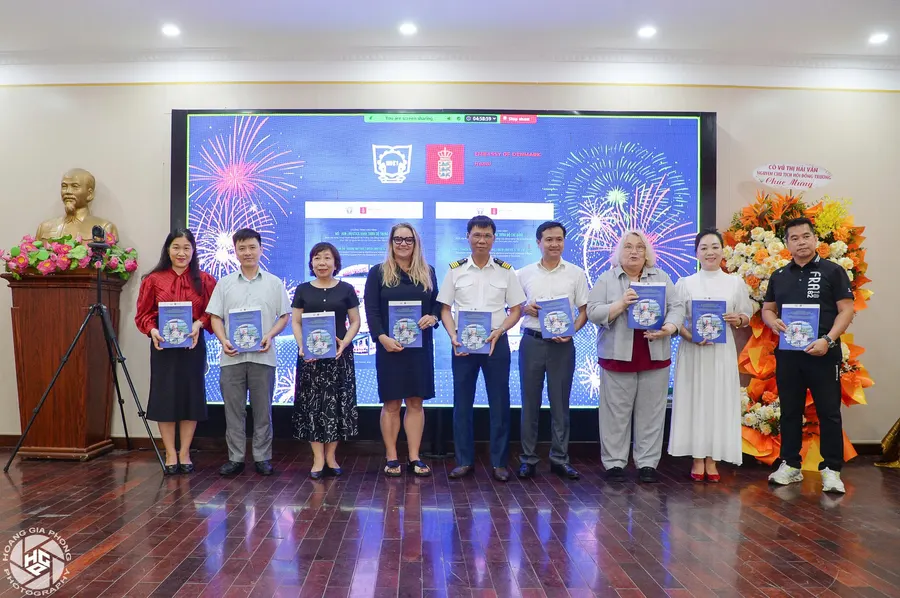
Delegates launch the Green Logistics Module at college and secondary vocational levels.
The event was honoured to welcome Ms Mette Ekeroth, Deputy Ambassador of Denmark to Viet Nam, and Ms Vibeke Holtum Bendix Nørgaard, Education Counsellor at the Embassy of Denmark. On behalf of state management agencies, there were representatives of the Ministry of Education and Training (MOET), the Viet Nam Maritime and Inland Waterway Administration and the Hai Phong Department of Education and Training. The workshop also brought together representatives of the Australian Embassy, the Viet Nam Chamber of Commerce and Industry (VCCI) and the Viet Nam Ship Agents, Brokers and Maritime Services Association (VISABA), together with sector associations, logistics enterprises, vocational education institutions providing logistics training, colleges participating in phase 2 of the Vocational Education Development Project – Cooperation between the Governments of Denmark and Viet Nam (VDV), members of the team that developed the materials, vocational education experts, and the lecturers and students who took part in the pilot training under the project.
In his opening remarks, Dr. Đỗ Văn Tuấn, Rector of Maritime and Inland Waterway College No. I, expressed his special appreciation and deep gratitude to the Government of Denmark and the Embassy of Denmark in Viet Nam. He emphasised: "Advanced experience from Denmark's 'dual training' model has been distilled and brought together in this set of training materials, giving us the confidence to develop a generation of logistics workers who are not only highly skilled but also carry a sustainable mindset."
Delegates press the button to launch the Green Logistics Module at Maritime and Inland Waterway College No. I.
Continuing the programme, Ms Mette Ekeroth, Deputy Ambassador of Denmark, said she was impressed by the determined, well-organised pace of implementation and the innovative spirit of the College's experts and lecturers. The success of the project is vivid evidence of the strategic and effective partnership between Denmark and Viet Nam in education and sustainable development.
Speaking at the launch ceremony, Mr Đào Trọng Độ, Head of the Vocational Education Division, Department of Vocational and Continuing Education (MOET), emphasised: "The green transition is no longer a future trend but a present requirement, and integrating green skills into training programmes is an urgent requirement for the vocational education system. The development of the 'Green Logistics Module at college and secondary vocational levels' materials is a highly practical initiative that contributes to improving training quality and meeting labour market needs. I highly appreciate the idea behind the project, the valuable support of the Government of Denmark, and the proactive and responsible role of Maritime and Inland Waterway College No. I and the other stakeholders. I believe that vocational education institutions, lecturers and enterprises will take an interest in studying these materials and apply them flexibly in training and in practice."
Mr Vũ Trí Quang, Deputy Director of the Hai Phong Department of Education and Training, congratulated Maritime and Inland Waterway College No. I on its excellent completion of the Green Logistics Module project and commented: "These materials are a high-quality product that clearly reflects the orientation towards green transition and international integration in vocational education in the locality. The Hai Phong Department of Education and Training highly appreciates the College's proactiveness and creativity. We will continue to accompany the College and create conditions for the Green Logistics module to be scaled up, contributing to improving the quality of the green logistics workforce for the port city of Hai Phong."
Overview of the workshop.
The workshop heard a presentation by Dr. Đào Minh Trang of the Viet Nam Institute of Meteorology, Hydrology and Climate Change; a presentation sharing experience on "Integrating green skills into Danish Vocational Education and Training (VET)" by Ms Vibeke Holtum Norgaard, Education Counsellor at the Embassy of Denmark in Viet Nam; a contribution from Tan Cang HITC, one of the enterprises participating in the pilot training; and a presentation on the project "Developing a green logistics module for vocational training to support the green transition in Viet Nam" by MSc. Trịnh Ngọc Thu Hà, Dean of the Faculty of Economics and Technology, Maritime and Inland Waterway College No. I, and leader of the team that developed the materials. This was followed by an expert panel discussion with representatives of state management agencies, the development team and GoldenLink and Minh Giang, enterprises that took part in the pilot class.
To ensure practicality and close alignment with market needs, the Green Logistics Module curriculum and textbook were developed by a team of six experts led by MSc. Trịnh Ngọc Thu Hà (Dean of the Faculty of Economics and Technology, Maritime and Inland Waterway College No. I), with the following members: MSc. Phan Huy Đức (Vice Rector, Ho Chi Minh City College of Transport); MSc. and doctoral candidate Ngô Như Tại (Member of the Board of Directors, UWG Integrated Warehousing JSC); Mr Nguyễn Quốc Cường (Chief Technology and Information Security Officer, U&I Logistics JSC, Ho Chi Minh City); Dr. Đào Anh Quang (Duy Tan University), an expert who studied the circular economy in Denmark; and MSc. Đồng Phong Huyền, Deputy Dean of the Faculty of Economics and Technology, Maritime and Inland Waterway College No. I.
Ms Mette Ekeroth, Deputy Ambassador of Denmark, speaks at the workshop.
The materials were developed on the basis of a survey of 59 enterprises across the North, Centre and South of Viet Nam. Beyond this, their quality was assured by a network of in-depth reviewers and commentators. On the side of state management and academic advice, the project received close support from Dr. Hà Đức Ngọc and MSc. Phùng Thị Kim Thoa (Vocational Education Division, Department of Vocational and Continuing Education), together with experienced experts such as Dr. Phạm Thị Minh Hiền (former coordinator of a Viet Nam–Denmark cooperation project and former Danish Government scholarship holder), Dr. Đào Minh Trang (Viet Nam Institute of Meteorology, Hydrology and Climate Change) and MSc. Trần Thị Thạch (TVET accreditation assessor, Quang Nam Vocational College).
In particular, the voice of practice was strongly reflected through input from leading organisations and enterprises in the sector, such as the Viet Nam Logistics Business Association (VLA), the Viet Nam Ship Agents, Brokers and Maritime Services Association (VISABA), the Logistics Industry Reference Committee (LIRC – Aus4Skills), and major companies including Transimex JSC, Golden Link JSC (GoldenLink), Minh Giang International Import-Export Trading Co., Ltd., Tan Cang – 189 Hai Phong JSC, T&M Forwarding Co., Ltd., Bee Logistics JSC and Jupiter Supply Chain Management JSC Hai Phong Viet Nam. In addition, the pedagogical applicability of the materials was refined thanks to contributions from partner training institutions: the College of Mechanics and Irrigation, the College of Agricultural Mechanics and Central Transport College No. V.
Mr Đào Trọng Độ, Head of the Vocational Education Division, Department of Vocational and Continuing Education, Ministry of Education and Training.
On behalf of the development team, MSc. Phan Huy Đức (Vice Rector, Ho Chi Minh City College of Transport) summarised the core principles for developing the module: "greening" should not be treated as a separate theoretical subject but must be integrated directly into professional skills, and training must be clearly tiered. Specifically, the secondary vocational level focuses on building habits (5S, 5R), while the college level extends to management thinking (calculating ROI, understanding ESG).
Mr Đức stressed an important philosophy: "The biggest lesson is that 'green' must become a culture and a professional working habit that brings economic benefits (reducing muda, or waste) to enterprises, rather than remaining merely a compliance requirement."
Discussion among representatives of state management agencies, experts and enterprises on developing and piloting the Green Logistics module.
The success of the in-company practical component came from the rigorous application of the internship toolkit transferred by the VDV project (Viet Nam–Denmark cooperation). Using this toolkit at the preparatory meeting stage enabled the College and the enterprises (Golden Link JSC (GoldenLink), Minh Giang International Import-Export Trading Co., Ltd., and Tan Cang Hai Phong International Container Terminal Co., Ltd. (TC-HICT)) to reach full agreement on objectives, responsibilities and the allocation of students according to the core strengths of each company. All parties rated this approach very highly for its professionalism. As a result, the partner enterprises were pleasantly surprised and affirmed that these students are a high-quality workforce, ready to help enterprises immediately meet the stringent ESG and Net Zero standards of global supply chains.
A particularly humane highlight of the pilot course was its complete gender balance, with 50% male and 50% female students, breaking the stereotype that logistics is a "heavy" field only for men. Most moving of all, the class included a student with a disability (who has lost one arm). Thanks to a training philosophy focused on thinking skills, digital tools and management competence, during practical training at the warehouses of GoldenLink, Minh Giang and Tan Cang HITC, he not only calculated carbon footprints excellently on the computer but also confidently joined his classmates in assessing 5S processes on site. This image strongly conveyed the vision of a green, inclusive vocational education environment in which "no one is left behind".
Students during a practical session of the pilot Green Logistics module class.
The pilot results show that students picked up "green" skills very quickly. The module completion rate reached 100%. The participating enterprises rated the readiness of students who completed the module as markedly higher than that of regular students, with 100% able to meet immediately the stringent ESG and Net Zero standards of global supply chains. The partner enterprises were pleasantly surprised and affirmed that these students are a high-quality workforce, ready to contribute immediately to production and business operations.
Notably, the Green Logistics Module breaks away from old training patterns by applying three philosophies:
First, a shift from "memorisation" to "performance competence": pure theory is kept to a minimum. Complex concepts such as "carbon footprint" or "return on investment (ROI)" are turned into practical exercises in Excel with step-by-step guidance.
Second, a "cognitive scaffolding" approach: starting by building a foundation of awareness about the environmental crisis, linking it to the logistics context, and only then going into specialised skills (transport, warehousing, packaging).
Third, evidence-based assessment (replacing paper-based examinations): students' competence is assessed on site through real tasks (waste sorting, using spill response kits, optimised packaging, etc.) and through defending their views in oral examinations.
With its feasibility and practical value proven through the pilot, the "Green Logistics Module" curriculum and textbook at college and secondary vocational levels are ready to serve as reference materials and to be applied flexibly at vocational education institutions nationwide, contributing to the Ministry of Education and Training's orientation of integrating green skills.
Concluding a dedicated research journey, the "Green Logistics Module" materials are now ready to become an effective tool for vocational education institutions across the country. With the support of the Government of Denmark, Vietnamese vocational education is taking firm steps on its journey to train a sustainable workforce and build a circular economy in the new era.