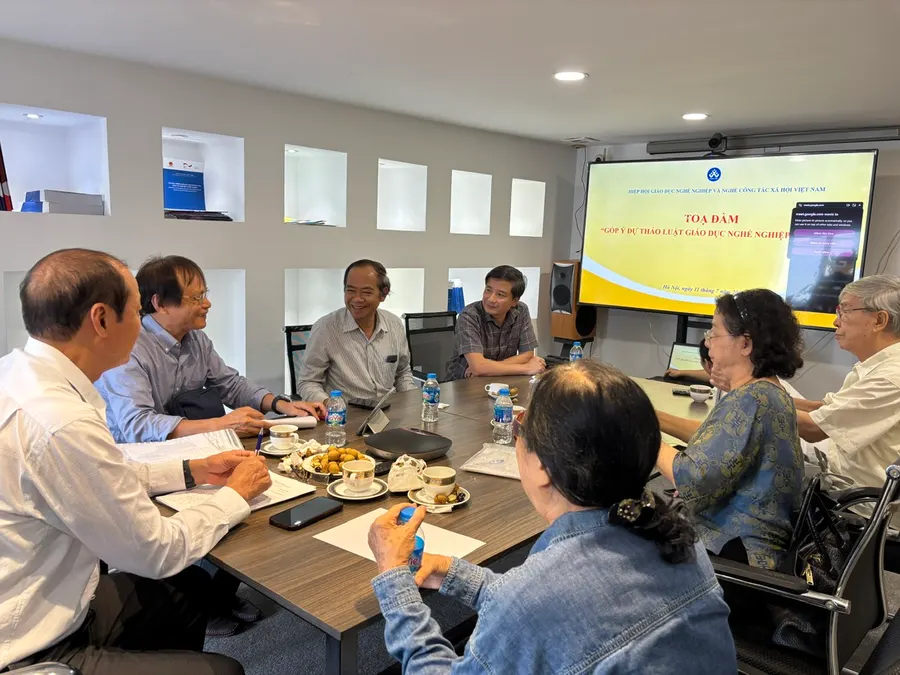
The seminar was attended by Dr. Phan Sỹ Nghĩa, President of VAVET&SOW; Assoc. Prof. Dr. Mạc Văn Tiến, Vice President and Secretary General of VAVET&SOW; Dr. Phan Chính Thức, former Vice President of VAVET&SOW; and more than 20 delegates, including leaders of many colleges and secondary vocational schools as well as scientists and education researchers from across the country.
At the seminar, delegates agreed that the draft (amended) Law on Vocational Education adds many reform-oriented provisions, most notably the recognition of the vocational upper-secondary programme – a model integrating general academic knowledge and vocational skills for students who have completed lower secondary school. The draft also extends the autonomy of vocational education institutions, sets out specific provisions on jointly appointed (co-permanent) lecturers, and raises the standards of training programmes and the quality assurance system.
In particular, many provisions have been adjusted, shortened or moved to related laws to reduce overlap and administrative procedures, making it easier for organisations and individuals to engage in vocational education and training (TVET). Provisions that are no longer appropriate, such as the classification of institutions, conditions for splitting and merging, and procedures for international joint training, have been removed or delegated to the competent authorities for detailed guidance.
The draft also adds provisions recognising prior learning and accumulated skills; extends college- and intermediate-level training to arts education institutions and institutions of the armed forces; and allows vocational education institutions to invest abroad, in line with the trend of comprehensive international integration.
Delegates also put forward a number of recommendations:
1. The substance of the development orientations for TVET over the coming decades needs to be clarified. Delegates strongly supported the Party's and the State's policy of building high-quality human resources to meet the country's development needs over the coming decades, or at least the next ten years, in response to the requirements of the "era of rising".
However, the draft (amended) Law does not yet clearly set out the substance of TVET development orientations for the years ahead. The Law should therefore set out specific orientations, models, solutions, mechanisms and policies to shape the development path of the TVET sector, especially in training high-quality human resources to meet the country's development needs over the coming decades.
In this regard, many delegates also recommended that the draft law should further clarify the role of State management in the TVET sector.
2. The vocational upper-secondary school model needs to be distinguished from the vocational upper-secondary programme offered in colleges and secondary vocational schools. Many delegates, especially leaders of colleges and secondary vocational schools, expressed concern that if the draft Law already recognises the vocational upper-secondary programme in specialised colleges and secondary vocational schools, there is no need to establish separate vocational upper-secondary schools, so as to avoid wasting resources and facilities. In particular, if vocational upper-secondary programmes are delivered in colleges and secondary vocational schools, they should be funded from the State budget, since the vocational upper-secondary track still falls within the scope of the general upper-secondary programme.
If vocational upper-secondary schools are nonetheless needed, they should provide training in a specialised field rather than across multiple fields, because multi-disciplinary vocational upper-secondary schools risk being superficial, lacking depth and ineffective.
The seminar was held both in person and online and received practical comments on the draft (amended) Law on Vocational Education.
3. The model of specialised vocational colleges and secondary vocational schools needs to be distinguished from college and intermediate-level programmes offered in universities. This was also an issue of concern to many delegates. Given that specialised vocational colleges and secondary vocational schools already exist, the development of college and intermediate-level programmes in universities should be reconsidered, as such programmes would create unfair competition for specialised vocational colleges and secondary vocational schools in enrolment and in awarding articulation (bridging) qualifications.
One delegate, the head of a vocational college, said frankly: universities specialising in academic training and research are also offering college and intermediate-level vocational training and then awarding articulation qualifications so that students can progress straight to university after completing college or intermediate programmes. This makes it very difficult to control the quality of student intake and outcomes, while putting colleges and secondary vocational schools at a disadvantage in enrolment.
4. The concept of autonomy for vocational education institutions needs to be clarified. Many delegates expressed concern about the concept of autonomy. Grade II and Grade III vocational education institutions currently face many difficulties with facilities and in attracting learners, and being required to be autonomous, especially financially autonomous, makes things even harder for them. The draft (amended) Law should therefore clearly distinguish full autonomy for Grade I vocational education institutions, while Grade II and Grade III institutions should only be given autonomy over the funding allocated to them.
The scope of autonomy also needs to be clarified. At present, the draft Law focuses heavily on financial autonomy but does not set out clearly enough autonomy in developing training programmes, in organisational structure, and in training partnerships and cooperation, among others.
Notably, many leaders of colleges and secondary vocational schools expressed concerns about the school council model. Grade I vocational education institutions, with a high degree of autonomy, need a school council to lead, direct, guide and oversee their operations. However, small and medium-sized Grade II and Grade III institutions, with limited autonomy and funding guaranteed by the State budget, do not need a school council, as it would add to the burden on their organisational structure and budget.
5. Enterprises need to see clearly what benefits, rights and legal status they have in training partnership models. Experience shows that the "dual training" model between vocational education institutions and enterprises needing vocationally trained workers has developed very effectively in recent years. This means enterprises actively take part in vocational training programmes within schools to produce learners with the qualifications and skills they need; or schools take part in training and retraining workers within enterprises to make work-based learning more effective, thereby reducing time and costs for enterprises.
However, the draft Law does not yet show clearly what benefits and rights enterprises will have in this training partnership model, in particular the significance, role and legal status of enterprises when they take part in such partnerships.
Summing up the seminar, Dr. Phan Sỹ Nghĩa, President of VAVET&SOW, stressed that the Association will continue to hold workshops and seminars to gather more comments from teachers, scientists, researchers and education managers on the draft (amended) Law on Vocational Education, and will promptly forward them to the drafting committee so that the draft Law can be finalised and submitted to the National Assembly for adoption as soon as possible.