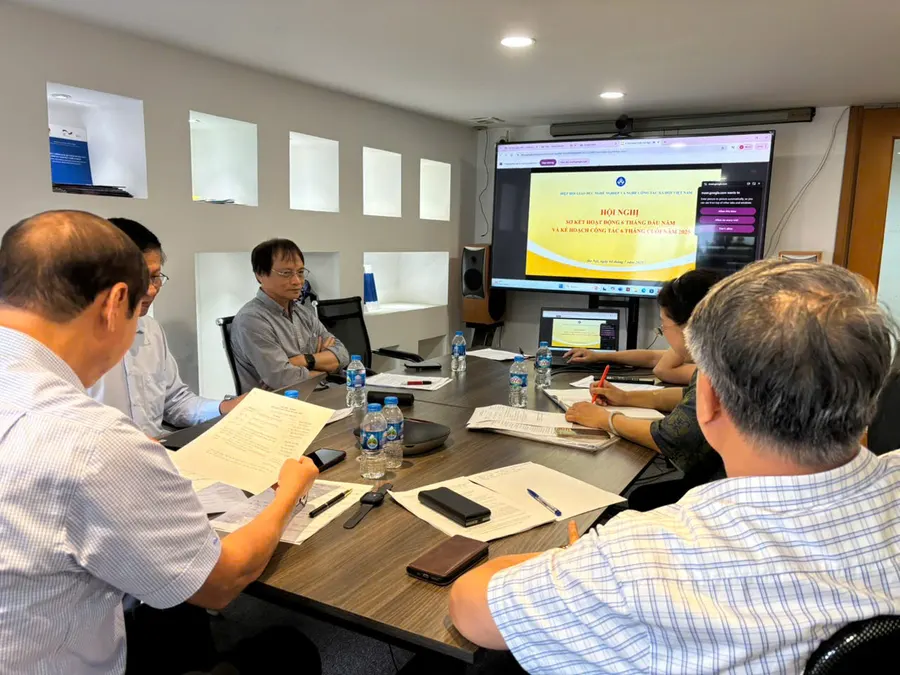
The conference was chaired by Dr. Phan Sỹ Nghĩa, President of the Association. Assoc. Prof. Dr. Mạc Văn Tiến, Vice President and Secretary General of the Association, members of the Association's Executive Committee and leaders of the Association's affiliated units attended the conference.
The conference reviewing activities in the first six months and rolling out the work plan for the last six months of 2025 was held both in person and online.
Overcoming difficulties and turning challenges into drivers of development
In his opening remarks, Dr. Phan Sỹ Nghĩa, President of the Association, stressed that during the first six months of the year the Association had been strongly affected by the nationwide restructuring of the government apparatus into a two-tier model; at the same time, the change of its supervising agency and the new coordination mechanisms had made the Association's work more difficult. Nevertheless, with a sense of responsibility and a proactive approach, the Association had gradually overcome these difficulties and achieved many encouraging results.
Amid considerable changes in management mechanisms and organisational structures, and a broad trend towards digital transformation, the Association has remained steadfast in its approach of renewing its thinking and adapting flexibly, bringing about clear changes in its professional, policy, communication and international cooperation activities, and continuing to affirm its role as a pioneering socio-professional organisation that connects with and accompanies the national vocational education and training (TVET) system.
Promoting professional activities and connecting with practice and the labour market
Presenting the report on the Association's results for the first six months and its plan for the last six months of the year, Assoc. Prof. Dr. Mạc Văn Tiến, Vice President and Secretary General of the Association, said: "Over the past period, the Association has established a new TVET cooperation centre and completed a bid to take part in the 'Skills Development and Vocational Training' package of a project funded by the Australian Government. The Association's Representative Office in Ho Chi Minh City has also been very active in organising thematic workshops on digital transformation in schools and the application of AI in teaching", among other activities.
The Association has also registered to take part in the 46th WorldSkills Competition in China in 2026, through private-sector funding, in two skills: Hairdressing and Fashion Technology. This is a strategic step demonstrating its determination to internationalise Vietnamese TVET.
In particular, the Beauty Vocational Training and Development Society, an affiliate of the Association, successfully held its 2024 year-end gala and is preparing to organise a vocational skills competition in beauty therapy and hairdressing modules at the end of this year.
It can be affirmed that the Association continues to hold its position and role as a hub connecting vocational education institutions with enterprises, and policy-makers with teaching staff and learners.
Contributing to TVET policy-making and protecting the interests of training institutions
A highlight of the first six months was the Association's active involvement in the revision of key laws: the 2014 Law on Vocational Education, the 2019 Law on Education, the Law on Employment, and others.
The Association sent a written recommendation to the Ministry of Education and Training (MOET) proposing that the network of vocational education institutions be kept stable, especially in the provinces newly formed through the merger of administrative units, at a time when legal documents are not yet consistent.
Based on feedback from members, the Association provided detailed comments on the draft revised Law on Vocational Education, including key documents such as the submission to the Government, the regulatory impact assessment, the formulation of policies into legal provisions, the legal review and the report on the law's implementation.
Stepping up communication, research and international connections
Over the past period, despite undergoing organisational consolidation, the magazine Nghề nghiệp và Cuộc sống (Career and Life), in both print and online editions, has promptly disseminated the policies of the Party and the State on TVET and social security, practical issues from the grassroots, and the obstacles in TVET that need to be removed and reflected in the revised Law on Vocational Education. At the same time, the magazine and the Association's website (vavet.vn) have kept information on the Association's activities up to date.
The Association is currently implementing a ministerial-level research project, "Research and proposal of a digital college model in Vietnamese TVET", and is preparing bids for a number of provincial-level research projects in Bắc Giang, Khánh Hòa, Tây Ninh, Phú Thọ and elsewhere.
In terms of international cooperation, the Association successfully organised the workshop "Viet Nam – China TVET Cooperation" in Hanoi in March 2025 with more than 180 participants. At the workshop, many Vietnamese and Chinese vocational education institutions signed training cooperation agreements, and a project to develop key vocational training programmes between the two countries was announced.
In addition, the Association has worked with KOICA (Korea), the German Chamber of Industry and Commerce (AHK) and the China Society of Automotive Engineers to explore opportunities for training partnerships and the supply of high-quality human resources to FDI enterprises in Viet Nam.
The last six months of 2025: focusing on the Congress for the new term and affirming the Association's role
The Association has identified six key tasks for the last six months of 2025:
First, actively carry out organisational work and prepare for the Association's 4th Congress of Delegates, term 2025–2030; complete the legal status of the Viet Nam – China TVET Cooperation Centre; work with the inspection team of the Ministry of Home Affairs; and recruit new members among vocational education institutions and enterprises.
Second, regarding participation in policy and law-making: continue to comment on the draft revised Law on Vocational Education, the Law on Education, the Law on Employment and the Law on Enterprises; and propose policies to stabilise the TVET network during the period of institutional transition.
Third, regarding professional and training activities: organise workshops and seminars on digital transformation, digital skills and AI in TVET; organise training courses for teachers and managers; implement the Aus4Skills project if the bid is successful; and organise a vocational skills competition in the beauty sector.
Fourth, regarding communication: step up communication on digital transformation, the semiconductor industry, renewable energy and the circular economy; and publicise the Association's 4th Congress, term 2025–2030.
Fifth, regarding scientific research: complete the ministerial-level research project and prepare bids for provincial and ministerial research projects for the 2026–2027 period.
Sixth, regarding international cooperation: co-organise a seminar and photo exhibition on "50 Years of Viet Nam – Germany TVET Cooperation" with GIZ; and organise in-depth workshops on Viet Nam – China cooperation in vocational education.
The conference received many useful contributions for the Association's work in the coming period. Many members of the Executive Committee delivered presentations focusing on the following issues: rather than merely commenting on policies already issued, the Association should proactively propose policies and prepare thematic recommendation reports based on field surveys. Its policy critique should be focused and targeted on pressing issues such as streaming after lower secondary school, the autonomy of vocational education institutions, the mechanism for commissioning and assigning tasks, remuneration policies for TVET teachers, and the award of national vocational skills certificates. It should broaden policy dialogue and bring in voices from the grassroots by organising annual or quarterly policy dialogue forums with the participation of teachers and managers of vocational education institutions and employers. It should train a team of experts capable of in-depth policy critique, with the Association establishing policy advisory boards or expert groups by field: training, legal affairs, labour economics, social affairs and so on. And it should connect and communicate to amplify its policy voice by developing the Association's communication channels (online newspaper, fan page, newsletters, special features, etc.) to spread its policy messages.
The conference strongly endorsed the supplementary election of several members of the Association's Executive Committee; the Resolution to convene the Association's 4th Congress, term 2025–2030; and the Resolution to rename the Association as the Viet Nam Association for Vocational Education and Training, among other decisions.
The forthcoming 4th Congress will be a milestone for the Association to review and evaluate its work, set out its future direction and affirm its role as a hub connecting regulatory agencies, training institutions, enterprises and workers, with the aim of building a comprehensive, modern, humane and internationally integrated TVET ecosystem.
Concluding the conference, Dr. Phan Sỹ Nghĩa, President of the Association, commended the results achieved by the Association and its affiliated units in the first six months of the year. He also appreciated the contributions made by participants regarding the Association's work in the coming period.
Dr. Phan Sỹ Nghĩa stressed that the Association would face considerable difficulties in the time ahead, but with the solidarity and determination of its leadership, staff and members nationwide, the Association is determined to successfully accomplish its plans. In particular, it is determined to hold a successful 4th Congress of Delegates, term 2025–2030, which is expected to take place in December 2025 in Hanoi.